
How to Make the Perfect French Press Coffee: A Complete Guide
How to Make the Perfect French Press Coffee: A Complete Guide
The French press is one of the most rewarding ways to brew coffee at home. No paper filters, no complicated machines, just coffee, water, and a few minutes of patience. But there is more to it than simply soaking grounds in hot water. Get the grind, ratio, and timing right and you will consistently brew a rich, full-bodied cup that rivals any cafe.
This guide covers everything you need to know, from choosing the right equipment to troubleshooting common mistakes.

In This Guide
What Is a French Press?
The French press is a simple immersion brewing device. Coffee grounds are steeped directly in hot water, then separated by pressing a fine metal filter down through the liquid. Unlike pour-over or drip methods, no paper filter is used, which means the natural oils from the coffee remain in the cup, giving French press coffee its characteristic richness and body.
The design dates back to the 1800s in France, but it was Italian designer Attilio Callimani who patented the modern version in 1929. Today it remains one of the most popular manual brewing methods in the world.
A quality French press has three key components: a heat-resistant borosilicate glass carafe, a fine metal filtration system with plunger, and a durable frame with handle. Simple, durable, and easy to clean.
What You Need
- Freshly roasted whole coffee beans
- French press (any size)
- Burr grinder
- Kitchen scale
- Kettle
- Water thermometer (optional)
- Long spoon for stirring
- Decanting vessel
Coffee to Water Ratio
Getting your ratio right is the single most important variable in French press brewing. Too much coffee and the cup will be overpowering and bitter. Too little and it will taste weak and flat.
The recommended range is 1:15 to 1:17 (coffee to water by weight). For most people, 1:17 is the sweet spot for a balanced, full-bodied cup.
| French Press Size | Water | Coffee (1:17) | Coffee (1:15 - stronger) |
|---|---|---|---|
| 2 cup (350ml) | 350g | 21g (~4 tbsp) | 23g |
| 4 cup (600ml) | 600g | 35g (~7 tbsp) | 40g |
| 8 cup (1L) | 850g | 50g (~10 tbsp) | 57g |
| 12 cup (1.5L) | 1,200g | 71g (~14 tbsp) | 80g |
Grind Size and Water Temperature
Grind size: Always use a coarse grind for French press. Because the coffee steeps in contact with water for several minutes, a fine grind will over-extract and produce a bitter, muddy cup. A coarse grind slows extraction and keeps the flavour balanced. Always use a burr grinder, not a blade grinder, for consistent particle size. For a full breakdown of grind sizes and their impact, see: Coffee Grinders and Grind Sizes Explained.
Water temperature: The ideal brewing temperature is 90-96 degrees Celsius. If you don't have a thermometer, bring water to a boil then let it sit for 30-60 seconds before pouring.
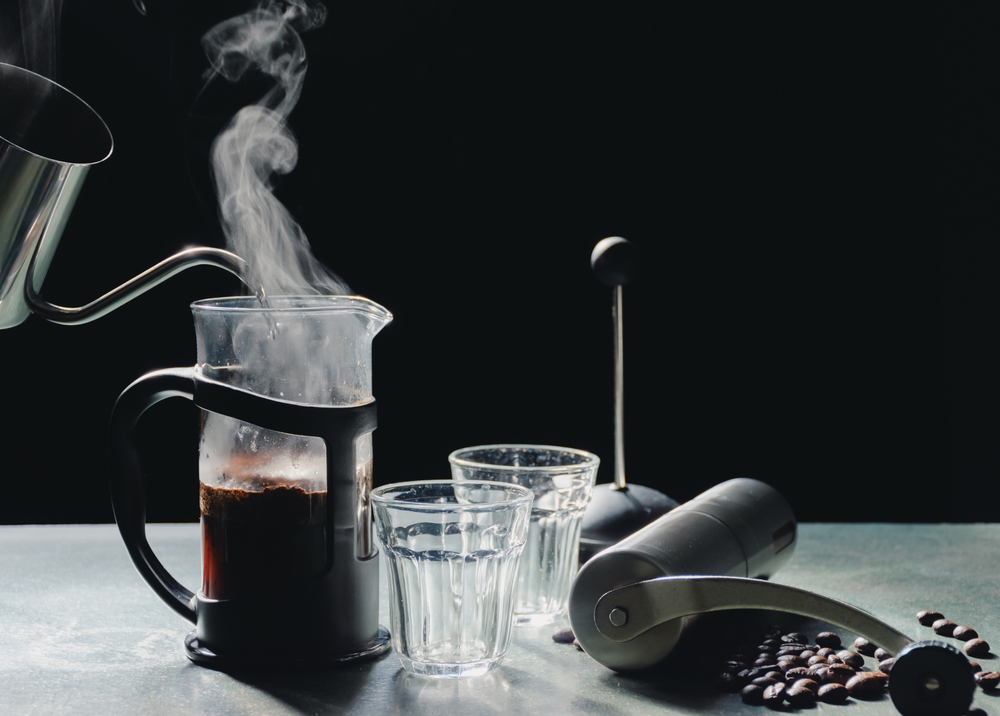
Step-by-Step French Press Brew Guide
Step 1 - Preheat your press: Add a small amount of hot water to the empty French press, swirl it around, then discard. This stabilises the brew temperature and stops the cold glass from pulling heat out of your water during extraction.
Step 2 - Weigh and grind your coffee: Place your French press on a kitchen scale, tare to zero, and measure your coffee. For an 8-cup press, use 50g. Grind coarsely using a burr grinder immediately before brewing. Fresh grinding makes a significant difference to flavour.
Step 3 - Heat your water: Heat water to 90-96 degrees Celsius. If you don't have a thermometer, boil and rest for 45 seconds.
Step 4 - Add water and stir: Pour hot water slowly over the grounds, making sure all the coffee is saturated. After 30-60 seconds, use a long spoon to gently stir and submerge any grounds floating on top. This ensures even extraction across all the grounds.
Step 5 - Place the lid and steep: Put the lid on with the plunger pulled up. This insulates the press and keeps heat in. Steep for 4 minutes for a standard cup. Adjust to 3.5 minutes for lighter, or 4.5-5 minutes for stronger.
Step 6 - Press slowly: Apply gentle, steady pressure to the plunger. It should take about 20-30 seconds to press fully. If there is too much resistance, your grind is too fine. If it drops with no resistance, your grind is too coarse.
Step 7 - Decant immediately: Pour all the coffee into a separate vessel straight away. Do not leave it sitting in the French press. Even with the plunger down, the grounds continue to extract and the coffee will become bitter within minutes.
Troubleshooting Common Mistakes
Coffee tastes bitter: Over-extraction. Try a coarser grind, reduce steep time by 30 seconds, or lower your water temperature slightly.
Coffee tastes weak or sour: Under-extraction. Try a finer grind (still coarse, just less so), increase steep time, or use hotter water.
Plunger won't press down: Grind is too fine. The grounds are clogging the filter. Lift slightly and try again, then use a coarser grind next time.
Lots of grounds in the cup: Your filter may be worn or the grind is too coarse. Try a slightly finer coarse grind, or pour through a secondary paper filter for a cleaner cup.
Coffee goes cold quickly: Preheat the press properly and consider a stainless steel French press which retains heat better than glass.
For a full list of brewing mistakes and how to fix them, see: Coffee Brewing Mistakes and How to Fix Them.Your French press deserves better beans.
Coffee Hero's freshly roasted whole beans are roasted to order and delivered within days, so every press starts with peak-fresh coffee.
Shop Coffee BeansFrequently Asked Questions
What is the best coffee to water ratio for French press?
The recommended ratio is 1:15 to 1:17 (coffee to water by weight). For a standard balanced cup, use 1:17, which means 50g of coffee to 850g of water for a large 8-cup press. Adjust to 1:15 if you prefer a stronger brew.
How long should you steep French press coffee?
The standard steep time is 4 minutes. Steep for 3.5 minutes for a lighter cup or up to 5 minutes for a stronger, bolder brew. Always decant immediately after pressing to stop extraction.
What grind size is best for French press?
Always use a coarse grind. Fine grounds over-extract during the long steep time and produce a bitter, muddy cup. Use a burr grinder for consistent particle size.
Should you always decant French press coffee?
Yes. Even after pressing, the grounds remain in contact with the liquid and continue to extract. If you leave the coffee sitting in the press for more than a few minutes, it will become increasingly bitter. Always pour into a separate vessel immediately after pressing.
Can you use French press for cold brew?
Yes. Use a coarse grind, combine with cold water at a 1:8 ratio, and steep in the fridge for 12-24 hours. Press and serve over ice. For a full cold brew guide, see: Cold Brew Coffee: Everything You Need to Know.
What is the best coffee bean for French press?
Any freshly roasted specialty Arabica bean works well. Medium to dark roasts tend to shine in a French press due to their fuller body and lower acidity. Buy whole beans and grind just before brewing for the best results.
Related Reads
Coffee Grinders and Grind Sizes Explained - Understand coarse vs fine grind and how it affects extraction in every brew method.
Coffee Brewing Methods: The Complete Guide - Compare French press, pour-over, AeroPress, Moka pot and more to find your ideal brew method.
Best Way to Store Coffee Beans - Keep your beans fresh between brews with the right storage method.